
Short Communication
The Gut-Reproductive Axis and Female Fertility: An Overview
- Swarup K. Chakrabarti *
H. P. Ghosh Research Center, New Town, Kolkata, West Bengal, India
*Corresponding Author: Swarup K. Chakrabarti, H. P. Ghosh Research Center, New Town, Kolkata, West Bengal, India
Citation: Chakrabarti SK. (2026). The Gut-Reproductive Axis and Female Fertility: An Overview, Journal of Women Health Care and Gynecology, BioRes Scientia Publishers. 6(2):1-5. DOI: 10.59657/2993-0871.brs.26.111
Copyright: © 2026 Swarup K. Chakrabarti, this is an open-access article distributed under the terms of the Creative Commons Attribution License, which permits unrestricted use, distribution, and reproduction in any medium, provided the original author and source are credited.
Received: May 12, 2026 | Accepted: July 13, 2026 | Published: July 23, 2026
Abstract
Female fertility is now understood to be a systemic phenomenon, where hormone release, immunity, metabolism, environmental factors, and neuroendocrine control play crucial roles. Recent data indicate that the gut microbiome plays an important role as a regulator of female reproduction through the gut-reproductive axis involving hormonal signals, immunity, metabolism, and epigenetics. Environmental and social factors like nutrition, stress, and pollutants can alter the gut microbiome and possibly cause reproduction disorders. The products of microbial metabolism, such as short-chain fatty acids, might affect estrogen biosynthesis, inflammation processes, and gamete formation through epigenetic processes. The connection between dysbiosis and disorders like PCOS, endometriosis, and infertility has been observed; however, the causal link is yet to be proven.
Graphical Abstract
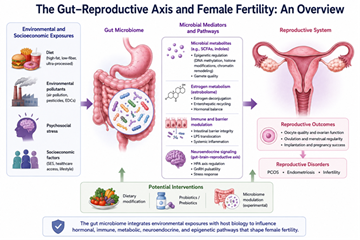
Note: This figure was generated using ChatGPT (OpenAI, GPT-5.3) via text-to-image conversion and subsequently refined through manual editing for clarity and presentation.
Keywords: gut microbiome; female fertility; gut–reproductive axis; epigenetics; short-chain fatty acids; dysbiosis; PCOS; endometriosis; reproductive health; environmental exposures; estrobolome; neuroendocrine signaling
Gut Microbiome and Female Reproductive Health
Fertility in females is increasingly being viewed as a systems-based phenotype mediated through complex endocrine, immune, metabolic, environmental, and neuroendocrine interactions, rather than solely through the functioning of reproductive organs [1-4]. Within this framework, the gut microbiota has emerged as a key regulator of host physiological functions. Studies in germ-free animal models have demonstrated alterations in hypothalamic-pituitary-gonadal (HPG) axis signaling, hormone regulation, and reproductive function, thereby supporting the existence of a gut-reproductive axis [5-7]. Environmental and socioeconomic factors critically modulate this axis upstream through their influence on gut microbial composition [8,9]. Diet remains one of the strongest determinants of microbial ecology. Diets high in fat, low in fiber, and rich in ultra-processed foods have been associated with reduced microbial diversity and depletion of short-chain fatty acid (SCFA)-producing bacteria, whereas fiber-rich diets support a metabolically favorable microbial environment [10,11]. Exposure to environmental toxicants, including air pollutants, pesticides, and endocrine-disrupting chemicals such as bisphenol A and phthalates, may also alter gut microbial composition [12,13]. Socioeconomic conditions can influence this axis at multiple levels by affecting dietary quality, environmental exposure burden, access to health care, and chronic psychological stress [14,15].
Accumulating evidence suggests that microbial metabolites may mediate environmental influences on reproduction through epigenetic mechanisms [16,17]. SCFAs and other microbiota-derived metabolites can influence histone acetylation, DNA methylation, chromatin remodeling, and other chromatin regulatory pathways that are important for metabolism, ovarian function, and gamete quality [18-21]. In addition, emerging evidence indicates that environmentally induced alterations in microbiota composition may contribute to epigenetic modifications in gametes [22-24]. Such alterations have been hypothesized to contribute to reduced fertility, supported in part by the identification of epigenetic signatures associated with poor-quality gametes [25,26]. Histone modifications and chromatin remodeling are known to influence fertility; for example, abnormal accumulation of histone H3 lysine 4 dimethylation (H3K4me2) in sperm has been associated with impaired sperm quality and developmental defects [27,28]. Similarly, dynamic changes in DNA methylation during oocyte maturation are important determinants of oocyte quality [29,30]. The gut microbiota may influence reproductive physiology through both endocrine and immunological pathways. One important mechanism involves estrogen metabolism mediated by the estrobolome, in which bacterial β-glucuronidase activity promotes estrogen deconjugation and enterohepatic recirculation, thereby influencing systemic estrogen availability [31,32]. Several observational studies have reported associations between gut microbial diversity and circulating estrogen levels across different reproductive stages, including menopause [33,34]. Concurrently, disruption of gut barrier integrity during dysbiosis may permit translocation of microbial products such as lipopolysaccharide (LPS), contributing to systemic low-grade inflammation that has been associated with disorders including polycystic ovary syndrome (PCOS) [35,36].
Gut-derived metabolites, particularly SCFAs, add another dimension to microbiome-reproductive communication. Preclinical studies suggest that SCFAs modulate immune signaling, metabolism, and epigenetic regulation, and that diet-associated dysbiosis may adversely affect folliculogenesis and ovarian physiology [37-39]. The gut microbiome may also indirectly influence ovarian aging through modulation of oxidative stress and mitochondrial dysfunction, both of which are established contributors to reproductive senescence [40,41]. In addition to endocrine and immunological pathways, communication between the microbiota and the reproductive system may occur through neuroendocrine mechanisms involving the gut-brain-reproductive axis [42,43]. Germ-free animals exhibit exaggerated hypothalamic-pituitary-adrenal (HPA) axis responses to stress, which can be normalized following microbial colonization [44,45]. Stress-mediated suppression of gonadotropin-releasing hormone (GnRH) pulsatility may contribute to anovulation, while microbiota-derived metabolites may influence tryptophan metabolism and downstream neuroendocrine signaling [46,47].
These interactions are increasingly reflected in clinical associations between gut microbiome alterations and reproductive disorders. Altered gut microbial composition has been reported in patients with PCOS, endometriosis, and idiopathic infertility [48-51]. Reduced microbial diversity and compositional shifts have been associated with insulin resistance, hyperandrogenism, and inflammation in PCOS; however, no reproducible disease-specific microbial signature has yet been established [52,53]. Similar associations have been described in endometriosis and idiopathic infertility, although findings remain inconsistent across studies [54,55]. In light of these emerging connections, therapeutic modulation of the gut microbiome has gained attention as a potential strategy in reproductive medicine, although current applications remain largely experimental. Dietary interventions emphasizing increased fiber intake, along with probiotics and prebiotics, have been shown to improve gut microbial diversity and confer metabolic and anti-inflammatory benefits in PCOS [56,57]. However, their effects on reproductive outcomes remain insufficiently characterized.
In summary, the gut-reproductive axis provides an integrative framework linking microbial ecology, environmental exposures, endocrine biology, immunology, epigenetics, and reproductive physiology. Although substantial biological plausibility has emerged from preclinical and observational studies, much of the human evidence remains correlational. Further mechanistic and longitudinal studies are therefore required to establish causality and evaluate the translational potential of microbiome-targeted interventions in reproductive health.
Declarations
Conflict of Interest
The author does have anything to declare.
Funding
None.
Generative AI Statement
The author confirms that no content in this manuscript was generated by artificial intelligence (AI) tools without appropriate oversight. Any use of AI-assisted technologies (e.g., for language editing or formatting) has been transparently acknowledged, and the authors have reviewed and verified all content for accuracy, originality, and compliance with ethical standards. The author takes full responsibility for the work, including any errors or inaccuracies.
References
- Escorcia Mora P, Valbuena D, Diez-Juan A. (2025). The Role of The Gut Microbiota in Female Reproductive and Gynecological Health: Insights into Endometrial Signaling Pathways. Life (Basel). 15(5):762.
Publisher | Google Scholor - Silva ABP, Carreiró F, Ramos F, Sanches-Silva A. (2023). The Role of Endocrine Disruptors in Female Infertility. Mol Biol Rep. 50(8):7069-7088.
Publisher | Google Scholor - Silva ABP, Carreiró F, Ramos F, Sanches-Silva A. (2023). The Role of Endocrine Disruptors in Female Infertility. Mol Biol Rep. 50(8):7069-7088.
Publisher | Google Scholor - Dai M, Xu Y, Gong G, Zhang Y. (2023). Roles of Immune Microenvironment in The Female Reproductive Maintenance and Regulation: Novel Insights into The Crosstalk of Immune Cells. Front Immunol. 14:1109122.
Publisher | Google Scholor - Bock SL, Chow MI, Forsgren KL, Lema SC. (2021). Widespread Alterations to Hypothalamic-Pituitary-Gonadal (HPG) Axis Signaling Underlie High Temperature Reproductive Inhibition in The Eurythermal Sheepshead Minnow (Cyprinodon Variegatus). Mol Cell Endocrinol. 537:111447.
Publisher | Google Scholor - Song T, Mustafa SB, Li H, Zhang X, Wang G, et al. (2026). Transcriptomic Regulation of The Hypothalamic-Pituitary Axis by GnRH Immunization in Xizang Sheep. Anim Biotechnol. 37(1):2631819.
Publisher | Google Scholor - Qian Y, Fang X, Chen Y, Ding M, Gong M. (2024). Gut Flora Influences the Hypothalamic-Gonadal Axis to Regulate the Pathogenesis of Obesity-Associated Precocious Puberty. Sci Rep. 14(1):28844.
Publisher | Google Scholor - Bertollo AG, Santos CF, Bagatini MD, Ignácio ZM. (2025). Hypothalamus-Pituitary-Adrenal and Gut-Brain Axes in Biological Interaction Pathway of The Depression. Front Neurosci. 19:1541075.
Publisher | Google Scholor - Lin Y, Kouraki A, Cheetham NJ, Louca P, Bowyer RC, et al. (2026). Gut Microbiome Composition and Function Reflect Socioeconomic Deprivation. NPJ Biofilms Microbiomes. 12(1):25.
Publisher | Google Scholor - Singh RK, Chang HW, Yan D, Lee KM, Ucmak D, et al. (2017). Influence of Diet on The Gut Microbiome and Implications for Human Health. J Transl Med. 15(1):73.
Publisher | Google Scholor - Koletic C, Mrad A, Martin A, Devkota S. (2025). Diet's Impact on Gut Microbial Assemblage in Health and Disease. J Clin Invest. 135(11):e184319.
Publisher | Google Scholor - Ma W, Xiong X, Tian Z, Li L, Huang Y. (2026). Environmental Pollutants and The Gut Microbiota: Mechanistic Links from Exposure to Systemic Disease. Front Microbiol. 17:1737229.
Publisher | Google Scholor - Pan Q, Zuo C, Zhao Y, Zhao Y, Zhou Z, et al. (2026). Effects of Phthalate Exposure on Oral Microbiome Diversity and Enrichment of Gemella and Streptococcus. Int Dent J. 76(1):109292.
Publisher | Google Scholor - de Lima Pereira L, Herkrath FJ, Siqueira JH, do Carmo Leal M, de Abreu FM, et al. (2026). Associations Between Socioeconomic Status, Dietary Habits and Health-Related Quality of Life Among Children in Rural Riverside Communities: The Mediation Role of Food Insecurity. Qual Life Res. 35(2):41.
Publisher | Google Scholor - Salem M, Robenson J. (2025). The Impact of Socioeconomic Factors on Mental Health: A Conceptual Framework. Cureus. 17(7):e88244.
Publisher | Google Scholor - Yelleti G, Maripini N, Bolar Suryakanth V. (2026). Preeclampsia and Environmental Epigenomics: The Emerging Role of Air Pollution, Gut Microbiome, and Maternal Exposures in Disease Programming. Environ Epigenet. 12(1):dvag001.
Publisher | Google Scholor - Rubas NC, Torres A, Maunakea AK. (2025). The Gut Microbiome and Epigenomic Reprogramming: Mechanisms, Interactions, and Implications for Human Health and Disease. Int J Mol Sci. 26(17):8658.
Publisher | Google Scholor - Zhang Q, Liu Y, Li Y, Bai G, Pang J, et al. (2025). Implications of Gut Microbiota-Mediated Epigenetic Modifications in Intestinal Diseases. Gut Microbes. 17(1):2508426.
Publisher | Google Scholor - Zhao Y, Chen J, Qin Y, Yuan J, Yu Z, et al. (2025). Linking Short-Chain Fatty Acids to Systemic Homeostasis: Mechanisms, Therapeutic Potential, and Future Directions. J Nutr Metab. 8870958.
Publisher | Google Scholor - Li L, Zhao S, Xiang T, Feng H, Ma L, et al. (2022). Epigenetic Connection Between Gut Microbiota-Derived Short-Chain Fatty Acids and Chromatin Histone Modification in Kidney Diseases. Chin Med J (Engl). 135(14):1692-1694.
Publisher | Google Scholor - Zhang W, Mackay CR, Gershwin ME. (2023). Immunomodulatory Effects of Microbiota-Derived Short-Chain Fatty Acids in Autoimmune Liver Diseases. J Immunol. 210(11):1629-1639.
Publisher | Google Scholor - Misiti F, Sannella A. (2026). Climate Change, Epigenetics, Microbiota, and Health. Int J Environ Res Public Health. 23(3):388.
Publisher | Google Scholor - Reva K, Laranjinha J, Rocha BS. (2023). Epigenetic Modifications Induced by the Gut Microbiota May Result from What We Eat: Should We Talk about Precision Diet in Health and Disease? Metabolites. 13(3):375.
Publisher | Google Scholor - Crean AJ, Immler S. (2021). Evolutionary Consequences of Environmental Effects on Gamete Performance. Philos Trans R Soc Lond B Biol Sci. 376(1826):20200122.
Publisher | Google Scholor - Jalouli M, Rahman MA, Nahdi S, Harrath AH. (2026). Epigenetic Landscape of Female Infertility: An Integrated Bioinformatics Perspective on DNA Methylation, MicroRNAs, and Gene Regulatory Networks Across PCOS, Endometriosis, and Diminished Ovarian Reserve. Int J Mol Sci. 27(4):1785.
Publisher | Google Scholor - Matenge N, Evans JP, Batley J, Firman RC. (2025). Epigenetic Links Between Paternal Age, Reproduction, and Offspring Health: A Focus on sncRNAs. Reprod Fertil. 6(4):e250093.
Publisher | Google Scholor - Lismer A, Siklenka K, Lafleur C, Dumeaux V, Kimmins S. (2020). Sperm Histone H3 Lysine 4 Trimethylation is Altered in A Genetic Mouse Model of Transgenerational Epigenetic Inheritance. Nucleic Acids Res. 48(20):11380-11393.
Publisher | Google Scholor - Lismer A, Dumeaux V, Lafleur C, Lambrot R, Brind'Amour J, et al. (2021). Histone H3 Lysine 4 Trimethylation in Sperm is Transmitted to The Embryo and Associated with Diet-Induced Phenotypes in The Offspring. Dev Cell. 56(5):671-686.e6.
Publisher | Google Scholor - Ozturk S. (2025). The Dynamics of DNA Methylation, Histone Methylation and Acetylation During Oocyte Aging in Mammalian Species and Possible Interventions to Regulate Them. J Assist Reprod Genet. 42(9):2873-2885.
Publisher | Google Scholor - Serej O, Kowalik MK, Rekawiecki R. (2026). DNA Methylation in the Ovary and Uterus of Mammalian Animal Models: Implications for Reproductive Function. Genes (Basel). 17(2):228.
Publisher | Google Scholor - Wang H, Shi F, Zheng L, Zhou W, Mi B, et al. (2025). Gut Microbiota has The Potential to Improve Health of Menopausal Women by Regulating Estrogen. Front Endocrinol. 16:1562332.
Publisher | Google Scholor - Martínez-Nortes ME, Carrascosa-Romero C, Ávila-Gálvez MÁ, Espín JC. (2026). Impact of Long-Term Medication on Estrobolome-Associated Β-Glucuronidase and Sulfatase Activities: Implications for Estrogen Homeostasis in Postmenopausal Women. Maturitas. 206:108830.
Publisher | Google Scholor - Lim MJS, Parlindungan E, See E, Gan CH, Yap R, et al. (2026). Diet, the Gut Microbiome, and Estrogen Physiology: A Review in Menopausal Health and Interventions. Nutrients. 18(7):1052.
Publisher | Google Scholor - Yaghjyan L, Mai V, Darville LNF, Cline J, Wang X, et al. (2023). Associations of Gut Microbiome with Endogenous Estrogen Levels in Healthy Postmenopausal Women. Cancer Causes Control. 34(10):873-881.
Publisher | Google Scholor - Zhu S, Chen H, He B, Zhang Y, Li P, et al. (2025). Gut Microbiota Dysbiosis in Polycystic Ovary Syndrome: Focus on Diet, Probiotics, and Traditional Chinese Medicine. Front Microbiol. 16:1659783.
Publisher | Google Scholor - Du X, Su H, Huang Y, Liu J, Li Q, et al. (2026). Gut Microbiome Dysbiosis in PCOS: From Pathogenesis to Microbiome-Targeted Therapies. Front Endocrinol. 17:1747766.
Publisher | Google Scholor - Yang W, Zhang X, Wu B, Ni B, Lin H, et al. (2025). Gut Microbiota-Driven Dysbiosis of the SCFA-Immune Axis in Pediatric Allergic Rhinitis-Constipation Comorbidity: Mechanisms and Synbiotic Remodeling. Front Immunol. 16:1639359.
Publisher | Google Scholor - Gonnella F, Konstantinidou F, Di Berardino C, Capacchietti G, Peserico A, et al. (2022). A Systematic Review of the Effects of High-Fat Diet Exposure on Oocyte and Follicular Quality: A Molecular Point of View. Int J Mol Sci. 23(16):8890.
Publisher | Google Scholor - Moustakli E, Stavros S, Katopodis P, Potiris A, Drakakis P, et al. (2025). Gut Microbiome Dysbiosis and Its Impact on Reproductive Health: Mechanisms and Clinical Applications. Metabolites. 15(6):390.
Publisher | Google Scholor - Moustakli E, Messini C, Potiris A, Zikopoulos A, Arkoulis I, et al. (2026). The Gut-Extracellular Vesicle-Mitochondria Axis in Reproductive Aging: Antioxidant and Anti-Senescence Mechanisms. Antioxidants (Basel). 15(2):174.
Publisher | Google Scholor - Liu, X., Zhao, Y., Feng, Y., Wang, S., Zhang, J. (2025). Ovarian Aging: Mechanisms, Age‐Related Disorders, and Therapeutic Interventions. MedComm, 6(12):e70481.
Publisher | Google Scholor - Kasarello K, Cudnoch-Jedrzejewska A, Czarzasta K. (2023). Communication of Gut Microbiota and Brain via Immune and Neuroendocrine Signaling. Front Microbiol. 14:1118529.
Publisher | Google Scholor - Qi X, Yun C, Pang Y, Qiao J. (2021). The Impact of The Gut Microbiota on The Reproductive and Metabolic Endocrine System. Gut Microbes. 13(1):1-21.
Publisher | Google Scholor - Sudo N, Chida Y, Aiba Y, Sonoda J, Oyama N, et al. (2004). Postnatal Microbial Colonization Programs the Hypothalamic-Pituitary-Adrenal System for Stress Response in Mice. J Physiol. 558(Pt 1):263-75.
Publisher | Google Scholor - Luczynski P, McVey Neufeld KA, Oriach CS, Clarke G, Dinan TG, et al. (2016). Growing up in a Bubble: Using Germ-Free Animals to Assess the Influence of the Gut Microbiota on Brain and Behavior. Int J Neuropsychopharmacol. 19(8):pyw020.
Publisher | Google Scholor - Vigil P, Meléndez J, Soto H, Petkovic G, Bernal YA, et al. (2022). Chronic Stress and Ovulatory Dysfunction: Implications in Times of COVID-19. Front Glob Womens Health. 3:866104.
Publisher | Google Scholor - Iwasa T, Matsuzaki T, Yano K, Irahara M. (2017). Gonadotropin-Inhibitory Hormone Plays Roles in Stress-Induced Reproductive Dysfunction. Front Endocrinol. 8:62.
Publisher | Google Scholor - Crestani B, Uccella S, Pavone M, Barra F, Baggio S, et al. (2026). Gut Microbiota Alterations and Reproductive Tract Dysbiosis in Endometriosis: A Systematic Review. Medicina. 62(2):351.
Publisher | Google Scholor - Senthilkumar H, Arumugam M. (2025). Gut Microbiota: A Hidden Player in Polycystic Ovary Syndrome. J Transl Med. 23(1):443.
Publisher | Google Scholor - Xholli A, Cremonini F, Perugi I, Londero AP, Cagnacci A. (2023). Gut Microbiota and Endometriosis: Exploring the Relationship and Therapeutic Implications. Pharmaceuticals. 16(12):1696.
Publisher | Google Scholor - Doroftei B, Ilie OD, Dabuleanu Cretu AM, Selaru I, Lunguleac G, et al. (2026). Endometrial Microbiota-Targeted Therapies for Chronic Endometritis-Associated Recurrent Implantation Failure and Their Impact on IVF Outcomes: A Systematic Review and Methodological Quality Assessment. Acta Obstet Gynecol Scand. 105(3):418-435.
Publisher | Google Scholor - Liu S, Cheng L, Li S. (2025). Characteristics of Gut Microbiota in Patients with Polycystic Ovary Syndrome and Its Association with Metabolic Abnormalities: A Review. Int J Womens Health. 17:2165-2174.
Publisher | Google Scholor - He FF, Li YM. (2020). Role of Gut Microbiota in The Development of Insulin Resistance and The Mechanism Underlying Polycystic Ovary Syndrome: A Review. J Ovarian Res. 13(1):73.
Publisher | Google Scholor - Elahi Z, Mokhtaryan M, Mahmoodi S, Shahroodian S, Darbandi T, et al. (2025). All Properties of Infertility Microbiome in a Review Article. J Clin Lab Anal. 39(6):e25158.
Publisher | Google Scholor - Yuanyue L, Dimei O, Ling L, Dongyan R, Xiaomei W. (2025). Association Between Endometriosis and Gut Microbiota: Systematic Review and Meta-Analysis. Front Microbiol. 16:1552134.
Publisher | Google Scholor - Patel E. (2026). Dietary Interventions for Modulating the Gut Microbiome in PCOS Management. Front Endocrinol. 17:1713408.
Publisher | Google Scholor - Maddirevula MK, Nelson VK, Soliman M, Alanazi BK, Hegazy AMS, et al. (2025). Effect of Probiotic-Derived Metabolites on Hormonal and Metabolic Profiles in Women with Polycystic Ovary Syndrome: A Systematic Review and Meta-Analysis. Front Cell Infect Microbiol. 15:1680840.
Publisher | Google Scholor