Case Report
Innovative Three-Pour Investment Technique for Fabricating a Silicone Hand Prosthesis: A Precision Driven Approach
1Professor and Postgraduate Teacher, Department of Prosthodontics, Crown and Bridge and Oral Implantology, Bhojia Dental College and Hospital, Budh (Baddi), Teh. Baddi, Dist. Solan, Himachal Pradesh, India.
2Associate Professor and Postgraduate Teacher, Department of Conservative Dentistry and Endodontics, Bhojia Dental College and Hospital, Budh (Baddi), Teh. Baddi, Distt. Solan, Himachal Pradesh, India.
*Corresponding Author: Arpit Sikri, Professor and Postgraduate Teacher, Department of Prosthodontics, Crown and Bridge and Oral Implantology, Bhojia Dental College and Hospital, Budh (Baddi), Teh. Baddi, Dist. Solan, Himachal Pradesh, India.
Citation: Sikri A, Sikri J. (2026). Innovative Three-Pour Investment Technique for Fabricating a Silicone Hand Prosthesis: A Precision Driven Approach, International Journal of Biomedical and Clinical Research, BioRes Scientia Publishers. 6(5):1-5. DOI: 10.59657/2997-6103.brs.26.125
Copyright: © 2026 Arpit Sikri, this is an open-access article distributed under the terms of the Creative Commons Attribution License, which permits unrestricted use, distribution, and reproduction in any medium, provided the original author and source are credited.
Received: February 18, 2026 | Accepted: March 27, 2026 | Published: April 01, 2026
Abstract
Hands play a vital role in both functionality and personal identity. The loss of part of a hand affects not only appearance and physical capabilities but also mental well-being. A well-designed prosthesis helps restore hand length, safeguard the residual limb, and improve sensory feedback. Although implant-based prostheses provide superior results, their high cost makes them less accessible. An innovative method of flasking was developed. The wax pattern was flasked using a three-pour technique with Type IV die stone (Kalrock, Kalabhai Karson Pvt. Ltd., Mumbai, India) for both ventral and dorsal surfaces. The mold consisted of three components: (1) base with attached stump, (2) counter-part, and (3) detachable die stone section. Two tin flasks were welded to accommodate the stump length. Type II dental plaster (Kaldent, Kalabhai Karson Pvt. Ltd., Mumbai, India) was poured at the base, tapered for proper adaptation, with an iron rod marking the stump base for weight stabilization and dewaxing. After setting, Type IV die stone supported the dorsal end of the wax pattern, with a thin Type II plaster mix stabilizing it. Six anti-rotational grooves were carved to prevent movement. The mold was filled in three pours: the first stabilized the junction, the second the stump and rod, and the third covered the entire pattern, with Type IV die stone used for precision and durability.
Keywords: amputation; cosmetic; hand prosthesis; hollow prosthesis; three pour flasking technique
Introduction
Approximately 1.3 billion people worldwide live with disabilities, including more than 10 million amputees, of whom 3 million have lost an upper limb, primarily due to trauma [1]. The term "amputation" originates from the Latin word "amputare" and results in a limb stump that is managed through either reconstructive surgery or prosthetic rehabilitation [2]. Prosthetic devices help restore function, form, and aesthetics, often achieving better cosmetic outcomes than surgical reconstruction [3]. Maxillofacial prosthodontists and anaplastologists play a crucial role in rehabilitation; however, prosthetic retention remains a significant challenge due to factors such as weight, inadequate tissue support, or anatomical limitations. Prosthetic devices enhance independence, with active models replicating hand movements and passive ones focusing on aesthetics. Advances such as neural implants and nerve interfaces continue to improve prosthetic functionality, though challenges related to cost and usability persist [4].
The loss of a hand profoundly affects identity and mental well-being, especially in younger individuals. Partial hand amputations are the most common form of upper limb loss, leading to reduced grip strength and psychological distress. Fitting prostheses for such cases is particularly challenging due to variations in the residual limb, scar tissue, and sensory impairments, often resulting in high rejection rates [5]. Hand prosthetics strive to balance function and aesthetics, particularly in cases where reconstructive surgery is not an option. These devices support emotional recovery by restoring appearance, improving self-image, and facilitating social reintegration. Options range from passive and body-powered prostheses to externally powered and task-specific designs, selected based on individual patient requirements [6].
An innovative flasking method was developed using a three-pour technique with Type IV die stone (Kalrock, Kalabhai Karson Pvt. Ltd., Mumbai, India) for both ventral and dorsal surfaces. The mold consisted of three components: (1) base with attached stump, (2) counter-part, and (3) detachable die stone section. Two welded tin flasks accommodated the stump length. Type II dental plaster (Kaldent, Kalabhai Karson Pvt. Ltd., Mumbai, India) was poured at the base, tapered for proper adaptation, with an iron rod marking the stump base for weight stabilization and dewaxing. After setting, Type IV die stone supported the dorsal end of the wax pattern, and a thin Type II plaster mix stabilized it. Six anti-rotational grooves were carved to prevent movement. The mold was filled in three pours: the first stabilized the junction, the second stabilized the stump and rod, and the third covered the entire pattern, with Type IV die stone ensuring precision and durability.
Case Report
A 17-year-old female patient, who lost her left hand in a motorcycle accident, sought prosthetic treatment at Bhojia Dental College & Hospital, Baddi, India. The amputation extended from the first to fourth carpometacarpal joints, with the fifth metacarpal displaced laterally and fused. She had undergone multiple surgeries, including skin grafting, but additional reconstructive procedures were not feasible. During evaluation, her residual limb presented grafted skin, an unhealed suture line, and pain rated 7/10 on the VAS scale. She struggled with fine motor activities, as assessed by the DASH questionnaire, and sought both functional and aesthetic improvement. Due to financial limitations and the condition of her limb, advanced functional prostheses or extraoral implants were not suitable. Instead, a custom silicone prosthesis with passive phalanx movement was designed, incorporating a prefabricated, color-matched artificial nail.
Fabrication Process
Hand Impression: Alginate impressions were taken of both her residual limb and a matching donor hand.
Wax Pattern: A sectional wax pattern technique was used to ensure a precise fit.
Mold & Casting: An innovative flasking method was developed using a three-pour technique with Type IV die stone to create an accurate mold. The mold consisted of three main components: (1) the base section, which included the attached stump, (2) the counter-part, and (3) a removable die stone section that connected the base and counter-part. To accommodate the stump's length, two tin metal flasks were welded together at the center, creating the necessary flask size. Type II dental plaster (Kaldent, Kalabhai Karson Pvt. Ltd., Mumbai, India) was poured around the base in a tapered manner from all sides to ensure proper adaptation. An iron rod was placed at one end to mark the base's location for the stump, helping with weight stabilization and assisting in the dewaxing process. After the plaster set, a Type IV die stone base was prepared to support the dorsal end of the wax pattern. As the dorsal half of the wax pattern solidified and the material began to set, a thin layer of Type II dental plaster was applied over the die stone. To further increase stability, six anti-rotational grooves were carved into the plaster to prevent any rotation of the flasks during the packing stage. The mold was filled in three stages, starting with the first pour that reached the junction of the dorsal and ventral surfaces. The second pour then stabilized the stump and iron rod, while the final pour covered the entire wax pattern. Type IV die stone (Kalrock, Kalabhai Karson Pvt. Ltd., Mumbai, India) was utilized in key areas to enhance precision and durability (Figures 1 & 2).
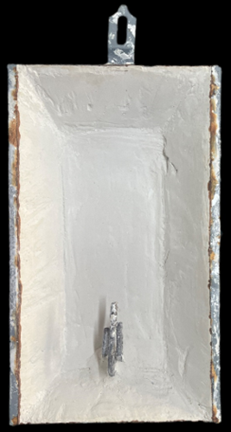
Figure 1: Innovative Flask Creation.
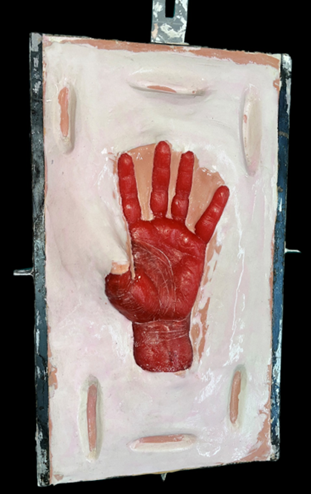
Figure 2: Flasking.
Silicone Prosthesis: Room-temperature vulcanizing (RTV) silicone was intrinsically color-matched and processed to produce a natural appearance.
Retention Enhancement: A smartwatch strap was integrated for added stability.
Outcomes & Follow-up
The prosthesis provided excellent retention, comfort, and aesthetic satisfaction. Follow-up evaluations at one week and three months revealed significant patient satisfaction, improved DASH scores, and no reported discomfort.
Maintenance
To ensure durability, the prosthesis required protection from sharp objects, heat, and harsh chemicals. Routine cleaning with mild soap, proper storage, and periodic inspections were advised.
This approach delivered a cosmetically and functionally effective prosthetic solution, enhancing the patient’s confidence and overall quality of life.
Discussion
Upper limb prostheses are classified into four categories based on the level of amputation: transmetacarpal, transcarpal, transradial, and transhumeral. Among these, transradial prostheses have seen the most technological advancements, while transmetacarpal prostheses remain less developed due to the complexity of replicating finger movements [7].
The primary goals of prosthetic rehabilitation include maintaining functionality, preventing joint contractures, and restoring the ability to perform daily tasks. Alginate is commonly used for impressions, with wax patterns crafted either from donor hands or impressions of the unaffected limb. In this case, a novel sectional wax pattern technique was introduced, enhancing adaptability and precision.
For fabrication, a three-part mold technique was employed to ensure accurate color customization and seamless silicone packing. A modified flasking approach, utilizing welded tin metal flasks and die stone bases, improved stability throughout the process. Retention strategies included vacuum effects, medical adhesives, and Biostar clear acrylic vacuum chambers, with adjustments made to enhance the fit [8].
Aesthetic considerations focused on precise shade matching and selecting a suitable nail color. Silicone was chosen for its highly realistic appearance, although it presents challenges in staining. The success of a prosthesis largely depends on comfort and natural aesthetics, with research highlighting psychological benefits, particularly for patients who cannot undergo surgical reconstruction [9].
While osseointegrated implants can provide sensory feedback, they were not considered in this case due to financial limitations [10]. The prosthesis was evaluated at two follow-up intervals (2 days and 3 months post-fitting), demonstrating significant improvements in object handling, pain reduction, and daily activities.
This custom-designed partial hand prosthesis proved to be an effective solution for the patient with a transmetacarpal amputation, enhancing both function and quality of life.
Conclusion
A cosmetic prosthesis provides significant psychological benefits by enhancing thumb mobility, improving stump functionality, and facilitating social integration. Its success depends on favorable stump conditions, realistic patient expectations, and strong motivation.
Modern silicone hand prostheses offer a balance of aesthetics, functionality, and comfort while helping to reduce social stigma. This study presents an innovative three-part mold technique for fabricating hollow prostheses, ensuring superior retention, simplified silicone packing, and precise color matching.
The three-pour technique offers several advantages, including high precision in fit. By progressively layering the investment material, this technique ensures an accurate reproduction of the anatomical structure, which is crucial for a detailed fit. It also enhances detail reproduction by allowing multiple pours at different stages, capturing fine details such as skin texture and anatomical contours, which are vital for achieving a realistic appearance in silicone hand prostheses. Additionally, the sequential pouring method reduces the risk of distortion, as each layer is allowed to set before the next one is poured, ensuring the final prosthesis closely mirrors the original model. The process also improves the prosthesis's strength by adding multiple layers of material, which enhances its structural integrity and makes it more durable and resistant to wear. The technique allows for highly customized prostheses that accommodate the patient’s specific anatomical features, providing a more personalized fit and appearance. Furthermore, it minimizes marginal errors by controlling the molding process at each stage, reducing the chances of gaps or misalignment, and ensuring a better seal and fit. The precise fit and attention to detail also contributes to the prosthesis's aesthetic appeal, giving it a natural look and feel. The sequential pouring method provides better control over the material's flow and setting time, minimizing the risk of air bubbles or imperfections.
However, the technique has its limitations. It is a time-consuming process that requires more time compared to conventional methods, which can extend the overall fabrication timeline. The technique's increased complexity also requires skilled technicians to properly layer and prepare the mold at each stage, which increases the risk of errors if not executed carefully. Additionally, the need for additional materials and the extended fabrication time can increase the overall cost of the prosthesis, making it less affordable for some patients. Specialized equipment or molds may be required, which could be a barrier for dental clinics or prosthetic labs with limited resources. Moreover, if the pouring process is not precisely controlled, inconsistencies in mold filling or curing can lead to defects such as uneven surfaces or compromised strength. The technique may also require specific investment materials, which might not always be readily available or may require custom sourcing. There is also the potential for over-curing each layer, which could affect the adherence of subsequent pours or the prosthesis's material properties, potentially impacting its performance. Finally, the technique demands a higher level of expertise, meaning only highly trained professionals can achieve optimal results.
Declarations
Source(s) of Support
None.
Presentation at a Meeting
None.
Conflicting Interest
None.
Acknowledgement
Nil.
References
- World Health Organization. (2011). World report on disability 2011. World Health Organization.
Publisher | Google Scholor - Stedman’s Medical Dictionary. (2006). Amputation. 28th ed. Philadelphia: Lippincott Williams & Wilkins.
Publisher | Google Scholor - Ziegler-Graham, K., MacKenzie, E. J., Ephraim, P. L., Travison, T. G., Brookmeyer, R. (2008). Estimating the Prevalence of Limb Loss in The United States: 2005 to 2050. Archives of Physical Medicine and Rehabilitation, 89(3):422-429.
Publisher | Google Scholor - Layton, D. M., Morgano, S. M., Muller, F., Kelly, J. A., Nguyen, C. T., et al. (2023). Glossary of prosthodontic terms 2023. J Prosthet Dent, 130(4S1):e1-e126.
Publisher | Google Scholor - Atkins, D. J., Heard, D. C., Donovan, W. H. (1996). Epidemiologic overview of individuals with upper-limb loss and their reported research priorities. JPO: Journal of Prosthetics and Orthotics, 8(1):2-11.
Publisher | Google Scholor - Peerdeman, B., Boere, D., Witteveen, H., Hermens, H., Stramigioli, S., et al. (2011). Myoelectric forearm prostheses: State of the art from a user-centered perspective. Journal of Rehabilitation Research and Development, 48(6):719-738.
Publisher | Google Scholor - Cuellar, J. S., Plettenburg, D., Zadpoor, A. A., Breedveld, P., Smit, G. (2021). Design of a 3D-printed hand prosthesis featuring articulated bio-inspired fingers. Proceedings of the Institution of Mechanical Engineers, Part H: Journal of Engineering in Medicine, 235(3):336-345.
Publisher | Google Scholor - Biddiss, E., Beaton, D., Chau, T. (2007). Consumer design priorities for upper limb prosthetics. Disability and rehabilitation: Assistive Technology, 2(6):346-357.
Publisher | Google Scholor - Schofield JS, Evans KR, Carey JP, Hebert JS. (2020). Applications of deep learning in prosthetics: A review. J Neuroeng Rehabil. 17(1):1-21.
Publisher | Google Scholor - Pylatiuk, C., Schulz, S., Döderlein, L. (2007). Results of an Internet survey of myoelectric prosthetic hand users. Prosthetics and Orthotics International, 31(4):362-370.
Publisher | Google Scholor