
Case Report
Foot Drop Occurring After Spinal Anesthesia, A Rare Complication
- Feras Al-Majmoai *
Rashid Hospital, Mohammed Bin Rashid University (MBRU), Dubai Health, Dubai, UAE.
*Corresponding Author: Feras Al-Majmoai, Rashid Hospital, Mohammed Bin Rashid University (MBRU), Dubai Health, Dubai, UAE.
Citation: Feras Al-Majmoai. (2026). Foot Drop Occurring After Spinal Anesthesia, A Rare Complication, Clinical Case Reports and Studies, BioRes Scientia Publishers. 12(5):1-2. DOI: 10.59657/2837-2565.brs.26.325
Copyright: © 2026 Feras Al-Majmoai, this is an open-access article distributed under the terms of the Creative Commons Attribution License, which permits unrestricted use, distribution, and reproduction in any medium, provided the original author and source are credited.
Received: April 14, 2026 | Accepted: April 28, 2026 | Published: May 23, 2026
Abstract
Foot drop is a rare neurological complication following spinal anesthesia, particularly after cesarean section. We report the case of a 27-year-old primigravida at 37+ weeks gestation who underwent an emergency cesarean delivery under spinal anesthesia for twin pregnancy and subsequently developed left lower limb weakness on postoperative day one. Clinical examination revealed impaired ankle dorsiflexion and plantarflexion with preserved hip and knee movement, accompanied by back pain and paresthesia. Neurological evaluation suggested common peroneal nerve injury, and the patient was managed conservatively with corticosteroids, analgesia, and physiotherapy, resulting in gradual improvement. Although spinal anesthesia is generally safe and widely recommended, neurological complications may arise due to factors such as direct needle trauma, local anesthetic neurotoxicity, or positional and anatomical variations. Early recognition, appropriate diagnostic evaluation, and supportive management are essential for favorable outcomes. This case highlights the importance of considering peripheral nerve injury in the differential diagnosis of postoperative motor deficits and reinforces that such complications are typically transient with good recovery prognosis.
Keywords: foot drop; spinal anesthesia; rare complication
Introduction
Neurological complications after regional anesthesia are rare. The prevalence is estimated to be 35 per 10,000 spinal anesthesia cases. Foot drop occurs from lumbosacral trunk and common fibular nerve injury. The symptoms include unilateral movement disorders of the ankles with paresthesia; however, this complication is rare after cesarean section.
Objective
To highlight a rare complication after C-section spinal anesthesia.
Methods
PubMed and a clinical case that presented to Al-Qassimi Women's and Children's Hospital Emergency Department as described below:
Clinical Case
27 years old primigravida,37+ weeks underwent emergency c-section under spinal anesthesia for twin pregnancy. No past medical or surgical history. Day 1 recovery postoperative patient had weakness and couldn't move her left leg and foot with back pain. she was not able to dorsiflex or plantarflex the ankle joint, no movements of the toes. hip flexion and knee joint flexion were possible with backache and tingling in the left foot however no complete motor block. started on IV dexamethasone and painkillers. the patient was seen by a Neurologist and diagnosed as common peroneal nerve injury. Power in left proximal lower limb 4/5. No weakness in hip/knee flexors, Foot flexion, extension present, power decreased. advised nerve conduction studies and physiotherapy. the patient was re-evaluated, and the weakness was gradually improving and advised for clinic follow-up with anesthesiology and neurology.
Table: Motor nerve studies: lower limb.
| Nerve | Site | Latency 1(ms) | Duration (ms) | Amplitude (mV) | Nerve conduction velocity (m.s-1) |
| Right | Ankle | 2.50 | 8.13 | 0.7 | 45.45 |
| Peroneal Nerve | Knee | 10.42 | 7.60 | 0.5 |
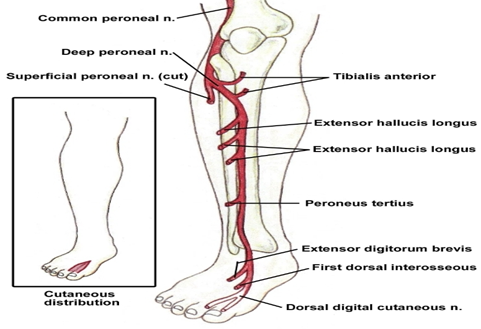
Figure
Results
Spinal anesthesia is recommended for cesarean delivery. the most frequent side effects include hemodynamic changes, nausea, vomiting, back pain, and headache. Neurological complications are rare and transient, with a prevalence of about 3.5%. The most common causes of these complications include direct needle trauma and local anesthetic-induced neurotoxicity. Needle placement or injection Paresthesia are the most frequent contributors of lumbosacral nerve injury. Needle size, anesthetic dose, and local anesthetic type have been illustrated to be effective in the development of neurological complications. Moreover, there are spinal conus anatomical variations. Foot drop is associated with common peroneal nerve damage, radiculopathy, relative sciatic nerve lesions, lumbosacral lesions, or cauda equina syndrome. Neurological paralysis due to long-term labor lithotomy position is three to four times more common after regional anesthesia. Differential diagnosis of foot drop should be performed by neural, EMG evaluations and imaging. Long-term hemodynamic changes are included in the factors, which cause spinal cord ischemia and spinal artery thrombosis, involved in neurological complications. In this case, no hemodynamic changes were observed and the patient was not in the lateral position for long. The onset, duration and recovery time vary among patients. a study suggests all neurological problems initiated within 48 hours, and recovery took from 2 days to 3 months. In this case, the complication appeared immediately after spinal anesthesia recovery for 72 hours.
Conclusion
Foot drop is a rare neurological complication due to direct needle trauma or local anesthetic toxicity after spinal anesthesia. This complication is temporary and usually resolves within a short duration of days. In this case, the neurological complication appeared after cesarean delivery and anesthesia recovery, which was treated by corticosteroids and supportive measures without side effects.
References
- Dar AQ, Robinson AP, Lyons G. (2002). Postpartum neurological symptoms following regional blockade: a prospective study with case controls. Int J Obstet Anesth., 11(2):85–90.
Publisher | Google Scholor - Auroy Y, Narchi P, Messiah A, Litt L, Rouvier B, Samii K. (1997). Serious complications related to regional anesthesia: results of a prospective survey in France. Anesthesiology, 87(3):479–486.
Publisher | Google Scholor - Reynolds F. (2001). Damage to the conus medullaris following spinal anaesthesia. Anaesthesia, 56(3):238–247.
Publisher | Google Scholor - Selander D, Dhuner KG, Lundborg G. (1997). Peripheral nerve injury due to injection needles used for regional anaesthesia. An experimental study of the acute effects of needle point trauma. Acta Anaesthesiol Scand., 21:182–188.
Publisher | Google Scholor - Ahmad FU, Pandey P, Sharma BS, et al. (2006). Foot drop after spinal anesthesia in a patient with a low-lying cord. Int J Obstet Anesth., 15:233–236.
Publisher | Google Scholor